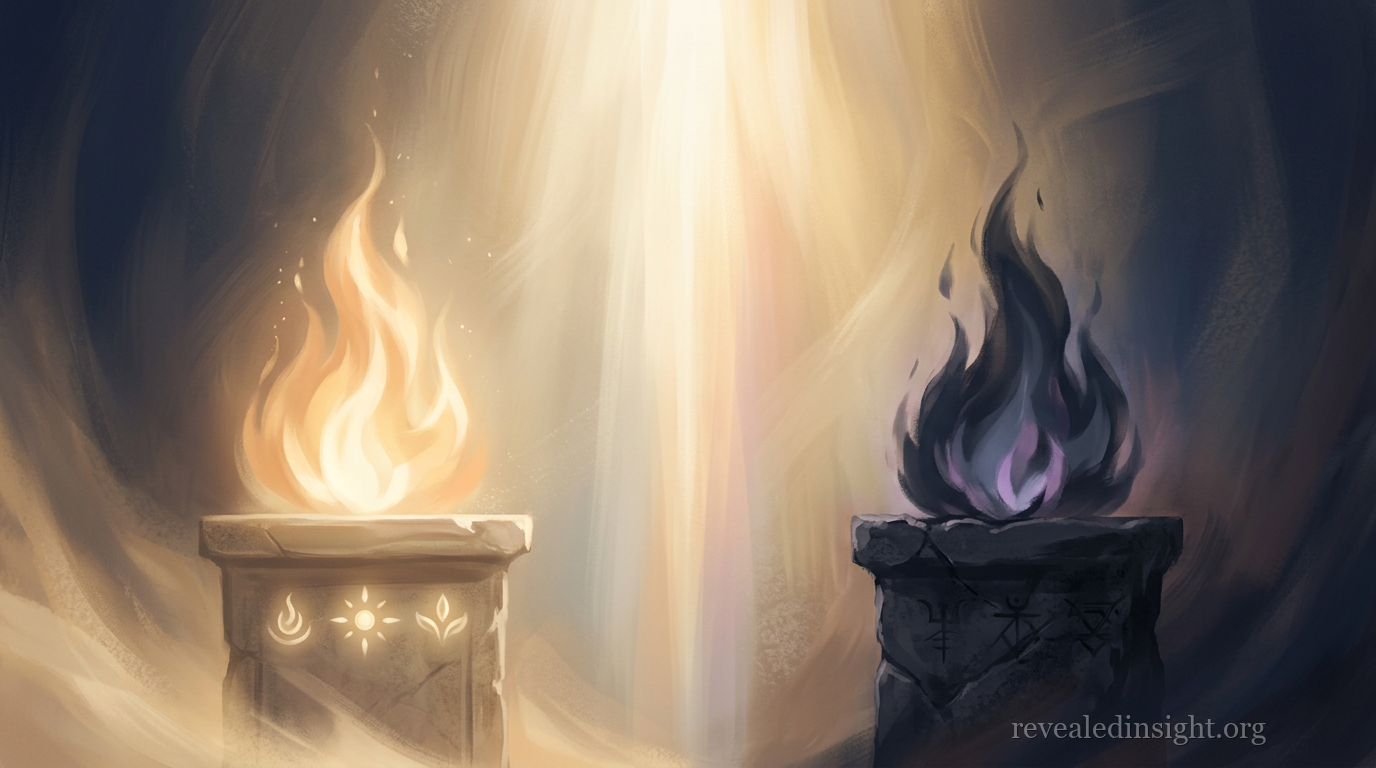
Altar vs. Altar: Understanding the Mechanics of Altars in Spiritual Warfare
An altar is not merely a religious structure — it is a covenant meeting point that grants legal authority to whatever spirit it is raised toward.
Without understanding what an altar is, Christians cannot effectively wage spiritual warfare. When a demonic altar backs the opposition, ignorance is not just a disadvantage — it is total defeat. This teaching unlocks the mechanics of altars from scripture, exposing why familiar spirits exist, why nations bleed, and why the modern church has lost the spiritual technology to combat what it cannot name.
Teaching Overview
- An altar is a covenant meeting point where blood is shed, giving legal spiritual authority to whatever spirit it is raised toward — God or demonic.
- Blood shed outside of God's ordained system creates a spiritual conundrum that affects individuals, families, and nations until it is spiritually corrected.
- Familiar spirits cannot exist in a family without an altar giving them legal ground — and when altars are broken, the spirits lose their right to remain.
- The modern church cannot wage spiritual warfare properly because it has lost the apostolic lineage and therefore lost understanding of altars.
- You cannot unknowingly serve another deity — worship is intentional, just as you cannot call on God or the devil by accident.
Key Distinctions
| Sin | Serving Another Deity | |
|---|---|---|
| What it is | Violation of God's law | Intentional worship directed toward a different spirit |
| Can it happen unknowingly? | Yes — a person can sin without full awareness | No — worship is on purpose and requires conscious direction |
| Spiritual consequence | Breaks relationship with God | Grants a spirit legal ground through an active altar |
| Biblical precedent | Ongoing human failure God addresses through mercy | God's anger provoked specifically by building altars to strange gods |
| Familiar Spirit | Demonic Spirit | |
|---|---|---|
| What it is | A spirit bound to a family through an altar | A spirit operating without familial altar attachment |
| What gives it access | An active altar maintained across generations | Direct spiritual encounter or invitation |
| Can it be cast out without addressing the altar? | No — the altar must be broken for the connection to be severed | Yes — can be dealt with through spiritual authority alone |
| What removes it | Breaking the altar removes its legal right | Direct spiritual warfare and deliverance |
| Godly Altar | Demonic Altar | |
|---|---|---|
| What it is | A covenant meeting point raised to God | A covenant meeting point raised to a demonic spirit |
| What it requires | Blood sacrifice and a priesthood | Blood sacrifice directed toward a strange spirit |
| What it produces | God's covenantal presence concentrated in a place or family | Legal ground for a demonic spirit to inhabit a family or territory |
| Effect when broken | Diminishes concentrated divine presence | Severs the familiar spirit's right to remain |
| Prayer for Someone | Someone Calling on God Themselves | |
|---|---|---|
| What it is | Intercession — praying on behalf of another | Personal petition — the individual calling on God directly |
| Why it works | God can intervene for another person when a third party invites Him | God responds because the individual themselves has opened the door |
| Why it is necessary | God gave the lease of the earth to man and cannot intervene without invitation | God already knows the need but requires human invitation to act |
| Biblical basis | "Pray for one another" — intercession for those who cannot represent themselves | The foundational principle that God cannot intervene in man's affairs unless a man invites Him |
Blood Speaks in the Spiritual Realm
- Blood is never supposed to be shed outside of God's ordained constitution — when it is, it creates a spiritual problem in the spirit realm that demands resolution.
- When Cain killed Abel, God's primary concern was not merely the moral wrong of murder but that innocent blood was calling out from the wrong location.
- Every nation that has dealt in the shedding of innocent blood will not know stability until the spiritual matter is corrected.
"Your brother's blood is calling to me."
"Until the spiritual thing is corrected, the country will never know peace. It's impossible."
The Origin and Purpose of Altars
- The first altar in scripture was built by Noah — and it was through this altar that God made His first covenant, establishing that an altar is where binding covenants are secured.
- Before altars existed among men, God never made a covenant — without an altar, there is no binding agreement.
- Every altar requires blood; an altar without blood is not a true altar.
"An altar is where covenants are made."
"An altar that does not require blood is a weak altar. In fact, it's not an altar at all."
The Garden of Eden as God's Sanctuary
- The Garden of Eden was God's own sanctuary — a place He had ordained to descend into at will, without needing man to call on Him.
- When God gave the lease of the earth to man, the dynamic shifted — God can no longer intervene in man's affairs without a man inviting Him.
- The first animal ever slain was in the garden, when God made skins to cover Adam and Eve — establishing the foundational principle that sin is covered through blood sacrifice.
"God cannot intervene in the affairs of man unless a man invites him."
"That is where the concept of sin being covered started from."
Altars Give Spirits Legal Ground
- An altar is a meeting point — it is the mechanism by which a spirit, whether divine or demonic, gains legal authority and concentrated access to a place or family.
- You cannot have a familiar spirit in your family without an altar — the altar is what gives the spirit the legal right to remain across generations.
- When Manasseh rebuilt the altars of Baal, familiar spirits, enchantments, and witchcraft all returned to Israel — confirming that when altars were broken, those spirits had no ground to stand on.
"You cannot have a familiar spirit in your family unless you have an altar."
"When the altars were broken, there was no more familiar spirits in Israel. But the moment altars were rebuilt, familiar spirits made a comeback."
The Loss of Apostolic Lineage in the Modern Church
- The modern charismatic church has lost the apostolic lineage, and with it, the understanding of altars and the priesthood required to maintain them.
- An altar cannot exist without a priesthood — and the only churches that still hold the apostolic lineage and a functioning priesthood are the Eastern Orthodox Church and the Catholic Church.
- Without this understanding, the church cannot wage spiritual warfare properly against demonic altars it cannot identify or name.
"You cannot have an altar without a priesthood."
"We lost the apostolic lineage. The only people who still have the apostolic lineage on earth, whether you like it or not, is the Eastern Orthodox Church and the Catholic Church."
Worship Is Always Intentional
- Sin can happen unknowingly, but serving another deity cannot — worship is always on purpose, directed consciously toward its object.
- Just as you cannot worship God by accident, you cannot call on the devil by accident — spiritual invocation requires intentional direction.
- The charismatic practice of labelling every cultural or unfamiliar act as witchcraft reveals a lack of understanding of how spiritual authority actually operates.
"You can sin unknowingly, but you cannot serve a different God without knowing what you're doing."
"Just like you can't worship God by accident, you can't call on the devil by accident."
Key Definitions
Altar — A covenant meeting point where blood is shed, concentrating spiritual presence and granting legal authority to the spirit toward whom it is raised.
Familiar spirit — A spirit bound to a family through an active altar that gives it legal right to remain across generations; it cannot exist in a family without that altar.
Intercession — The ability to pray on behalf of someone who cannot represent themselves before God, enabling God to intervene for them within the spiritual law that requires human invitation.
Apostolic lineage — The unbroken priestly succession that carries the spiritual authority and understanding required to maintain altars and conduct proper spiritual warfare.
Pleading the blood — A charismatic practice Prophet Lovy identifies as unbiblical — no scripture instructs believers to plead the blood of Jesus, and its misapplication stems from a lack of understanding of what an altar is.
Covenant — A binding spiritual agreement established at an altar through blood sacrifice; without an altar, no covenant is truly binding.
Key Takeaways
- An altar is a covenant meeting point that grants legal spiritual authority — understanding this is the foundation of all spiritual warfare, because without it you cannot identify what you are fighting.
- Familiar spirits require an altar to exist in a family — targeting the spirit without addressing the altar leaves the legal ground intact and the problem unresolved.
- Blood shed outside God's constitution creates a spiritual problem that affects nations — the instability of nations with histories of innocent bloodshed is not political but spiritual, and it cannot be resolved through natural means alone.
- The modern church cannot wage war properly because it lost the apostolic lineage — without a priesthood, there can be no altar, and without an altar, the church is spiritually outmatched by demonic structures it cannot dismantle.
- Worship is always intentional — you cannot unknowingly serve a deity, which means many accusations of witchcraft in the charismatic world are rooted in spiritual illiteracy, not discernment.
Reflection Questions
- Are there patterns of loss, instability, or recurring spiritual opposition in your family or community that may indicate an active demonic altar — and have you ever addressed the altar rather than only the symptoms?
- How much of your spiritual warfare strategy is based on what you have been taught versus what you actually understand from scripture? What would change if you built your practice on understanding rather than tradition?
- Have you ever labelled something as witchcraft or spiritual attack without actually understanding the mechanics behind it? What does this teaching reveal about the cost of that kind of spiritual illiteracy?
- God cannot intervene in man's affairs unless a man invites Him — knowing this, how does it change the way you approach intercession for unsaved family members or those who are not calling on God themselves?
- This teaching identifies the loss of apostolic lineage as a critical gap in the modern church's ability to fight spiritually. What responsibility does that place on you personally to seek deeper understanding rather than accepting what is commonly taught?
Prayers and Declarations
"My prayer for especially the Revelation Nation, who I am assigned to, I don't want you guys to be spiritually illiterate. It's very important for you to understand what you're dealing with."
Scripture References
- Genesis 3:21 — "Unto Adam also and to his wife did the LORD God make coats of skins, and clothed them." (KJV)
- Genesis 3
- Genesis 8:18-20
- Genesis 8:20 — "And Noah builded an altar unto the LORD; and took of every clean beast, and of every clean fowl, and offered burnt offerings on the altar." (KJV)
- 1 Kings 18
- 2 Kings 20
- 2 Kings 21:1-6 — "Manasseh was twelve years old when he began to reign, and reigned fifty and five years in Jerusalem. And his mother's name was Hephzibah. And he did that which was evil in the sight of the LORD, after the abominations of the heathen, whom the LORD cast out before the children of Israel. For he built up again the high places which Hezekiah his father had destroyed; and he reared up altars for Baal, and made a grove, as did Ahab king of Israel; and worshipped all the host of heaven, and served them. And he built altars in the house of the LORD, of which the LORD said, In Jerusalem will I put my name. And he built altars for all the host of heaven in the two courts of the house of the LORD. And he made his son pass through the fire, and observed times, and used enchantments, and dealt with familiar spirits and wizards: he wrought much wickedness in the sight of the LORD, to provoke him to anger." (KJV)
- Jeremiah 19:1-7
- Habakkuk 2:2
Golden Nuggets
"An altar is where covenants are made."
"You cannot have a familiar spirit in your family unless you have an altar."
"God cannot intervene in the affairs of man unless a man invites him."
"You are 100% destroyed if you don't understand what you are fighting with."
"When the altars were broken, there was no more familiar spirits in Israel. But the moment altars were rebuilt, familiar spirits made a comeback."
"You can sin unknowingly, but you cannot serve a different God without knowing what you're doing."
"You cannot have an altar without a priesthood."
"An altar brings forth the presence of God more than anything."
"God is everywhere but he doesn't appear everywhere."
"If you did not create life, you don't have the right to take it. It's not yours to take."
Resources and Further Reading
Read the Medium version of this article: [Medium link placeholder]
Free resources related to this teaching will appear here.
Related Teachings
Share this teaching